Case study · 2026
Hey G
A trading buddy you talk to out loud — coach, mentor, mind-trainer and news desk — that runs entirely on your machine, quotes your own books chapter and line, and by design never tells you what to trade.
A local, voice-first AI trading coach grounded in your own library
- Industry
- Capability build · Consumer AI & trading psychology
- Engagement
- Spec → local voice stack → on-device book RAG → compliance red-team → ship
- Result
- A trading buddy you talk to out loud — coach, mentor, mind-trainer and news desk — that runs entirely on your machine, quotes your own books chapter and line, and by design never tells you what to trade.
The challenge
A trader wanted the thing every “AI trading” product refuses to be: not a signal service, but a coach — a training partner, a mindfulness guide, a mentor, a news-watcher and an emotion logger — that actually knows the trading-psychology books he trusts, and that he could talk to out loud while the market is live. The brief even used the word “fine-tuned”: an AI steeped in specific books, giving playbook-grade coaching from them.
Two hard constraints sat underneath that. First, privacy and cost: a trader's journal, emotions and P&L are about as sensitive as personal data gets, and it had to run without shipping any of it to a cloud API or racking up per-token bills. Second — and non-negotiable — compliance: the instant an “AI coach” for traders drifts into “buy here, sell there,” it becomes an unlicensed signal service and a liability. The product had to be genuinely useful in the heat of a live session while structurally incapable of telling anyone what to trade.
And “knows my books” is deceptively hard to do honestly. Literally fine-tuning a model on a few books is expensive, brittle, and tends to blur what the book actually said with what the model invented. The real requirement wasn't weight-surgery — it was a coach whose advice is traceable to the trader's own shelf, not confabulated.
There was a subtler problem underneath the whole thing: the scoreboard corrupts the discipline it's meant to measure. A trader who grades a day by profit gets rewarded for a lucky rule-break and punished for a textbook loss — exactly backwards. The product needed a way to grade the decision, not the outcome, so that "I followed my plan and still lost" reads as the success it actually is.
What we built
We built Hey G local-first, voice-first. It runs as an always-on app bound to the trader's own machine: hold the spacebar, talk, and G replies in his own voice. The whole loop is on-device — whisper.cpp turns speech to text, a local Ollama language model does the thinking, and a local neural voice speaks the reply — so a spoken trade ("just went long cable, entry 1.2740, stop 1.2710") becomes a confirmed journal card without a single byte leaving the Mac. A cloud voice engine is supported if a key is present, but nothing requires it.
For “knows my books” we did the honest, robust thing instead of literal fine-tuning: on-device retrieval. Each book the trader imports is chunked and embedded locally (582 passages across his three books at build time), and on every coaching turn the most relevant passages are pulled in and cited — so G quotes the trader's own library, by chapter, and you can check him. It reads the same way a fine-tuned model would feel, but every claim is traceable to a real page rather than confabulated, and adding a new book is a drag-and-drop, not a retraining run.
To grade the decision instead of the money we built the **Execution Ledger**: after each trade the trader scores five things they control — was there a valid reason to look, did the written trigger print, was the risk accepted before entry, was there no hesitation, was it managed to plan. One tap for "clean," or mark what broke. That produces four honest quadrants — a clean win, a clean loss (a flawless trade that simply hit its stop — counted as a success), a system failure, and, most usefully, the *toxic win*: the rule-break the market happened to pay, flagged as the most dangerous line on the blotter. The dashboard then tracks execution accuracy over time, so discipline becomes a number you can raise that has nothing to do with luck.
Around that we built the whole coaching surface the brief described. A 90-second pre-session reset ("decide cold, then we trade") where you say your rules out loud and accept the risk before the trigger prints. A **Mind** studio with six areas — guided meditation, sixteen breathing techniques with an animated, audibly-cued pacer, safety-gated self-hypnosis, affirmation decks, six generative focus soundscapes that duck under G's voice, and desk-break movement — all surfaced by the moment you're in (pre-session, between trades, after a loss, end of day, off-desk), plus a Shelf of sixty-second tools on the live screen and a ten-day "Decide Cold" programme. Crucially, the "knows your library" idea extends to the trader's own voice: you can upload your own hypnosis script or write your own affirmation deck and G reads them back in his voice. Then a **Mentor Desk** (weekly report card, one-to-three process assignments, a printable pack for a human mentor); a **News Desk** (economic calendar plus headlines) that G reviews against your own rules but never turns into a call; **Playbooks** built from your own words; and a dashboard that keeps P&L hidden while surfacing expectancy, drawdown and an emotion×outcome map in R-multiples.
Compliance is the spine, not a footnote. A disclaimer gate opens every session; a streaming output filter screens G's words live, sentence by sentence, before they're ever spoken; and a blocking suite of 61 adversarial prompts — advice-seeking, distress, "turn this headline into a trade," "I'm ready to size up now" — must pass before anything ships. The red-team is semantic, not cosmetic: a refusal doesn't pass merely by avoiding banned phrases, it has to actually contain its boundary — the redirect to the trader's own written plan, the GP-and-Samaritans signpost, the off-desk safety line. And the duty of care is explicit: the breathing and hypnosis are framed as focus and recovery, never treatment, and anything heavier routes to a real professional, every time.
The outcome
Hey G exists as a complete, working product doing exactly what was asked, and then some: a coach you talk to, that trains your state, grades your execution, mentors your week, watches the news, logs your emotions against outcomes, and answers from your own trading-psychology books — around twenty screens and sixty local API endpoints, verified by 127 automated tests and a 61-prompt compliance red-team, running entirely on the trader's machine at £0 in tokens. It's grounded, not generic: ask G what your own book says and he quotes it back with the chapter. It even remembers across days — it writes its memory of a session and brings your commitment up the next morning.
The governance is what makes it defensible. Because it's local, the trader's journal, emotions, books and P&L never leave the device — there's no account, no cloud, and the calm-me-down reset works with the network unplugged. Because coaching is grounded in retrieval with citations, its advice is checkable rather than invented. And because compliance is architectural — a gate, a live filter, and a red-team that blocks release — it stays firmly on the right side of the line: G coaches process and state, and refuses, every time, to tell you what to trade. It ships as an always-on service with nightly, verified backups.
Commissioned cold, a voice-first AI product like this — local speech, a local model, on-device retrieval over the user's own library, plus a full coaching suite and a compliance red-team — is a £120k–£220k specialist build over four to eight months. It was designed and built AI-accelerated in days. That's the proof point we care about most: it's the living, interactive companion to the printable journal from our Trueflow in Action build, and it shows CIA shipping private, on-device, compliance-first AI — the exact shape of AI a regulated or sensitive business can actually deploy.
“The brief said “fine-tune an AI on my trading books.” We did something more honest and more useful: a coach that runs entirely on your machine and quotes your own library chapter and line — while, by design, it can never tell you what to trade.”
See it in action
The working build, captured screen by screen.
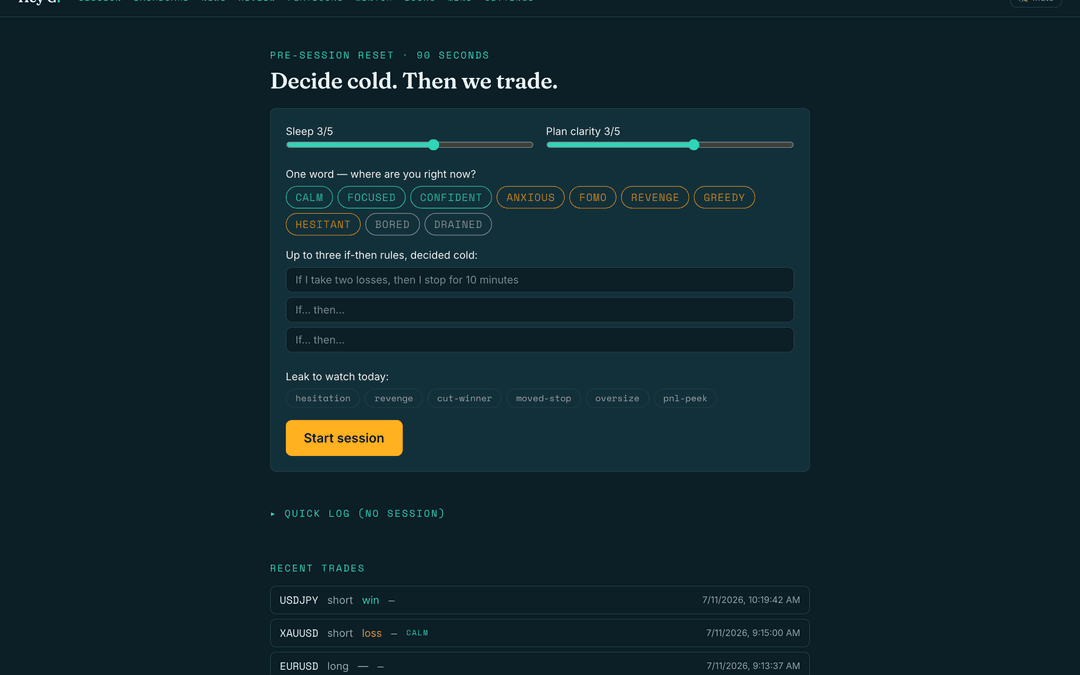
Pre-session reset — “decide cold, then we trade”: a state word, up to three if-then rules and the leak to watch, before a single trade.
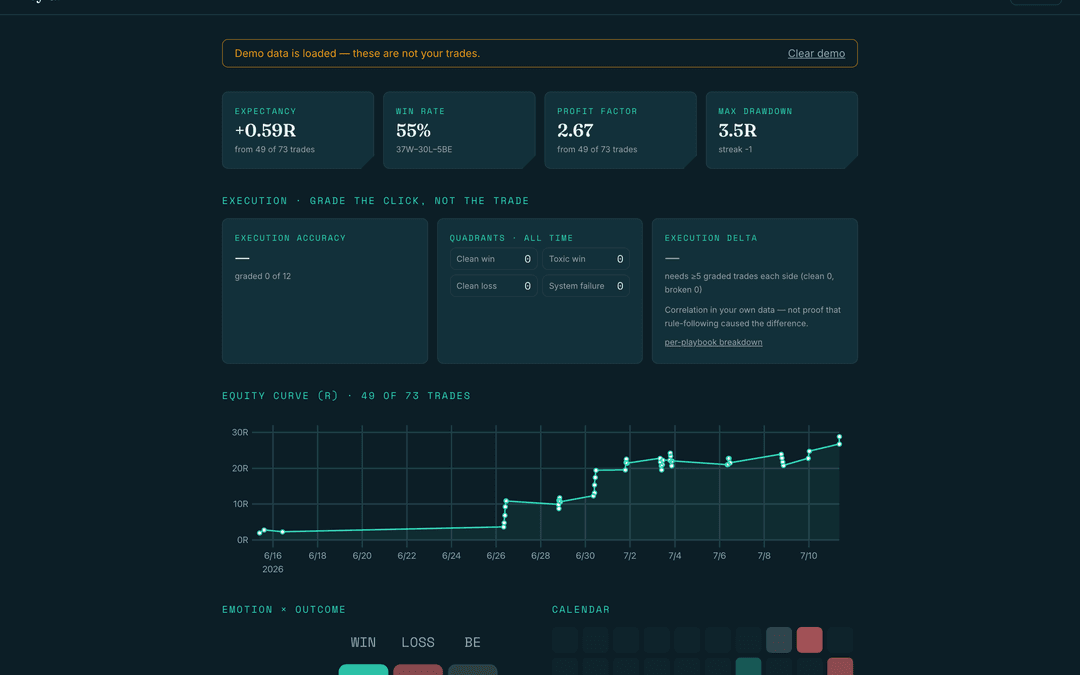
Dashboard — expectancy, win rate and drawdown in R, an equity curve and an emotion×outcome map; P&L stays hidden until you deliberately peek.
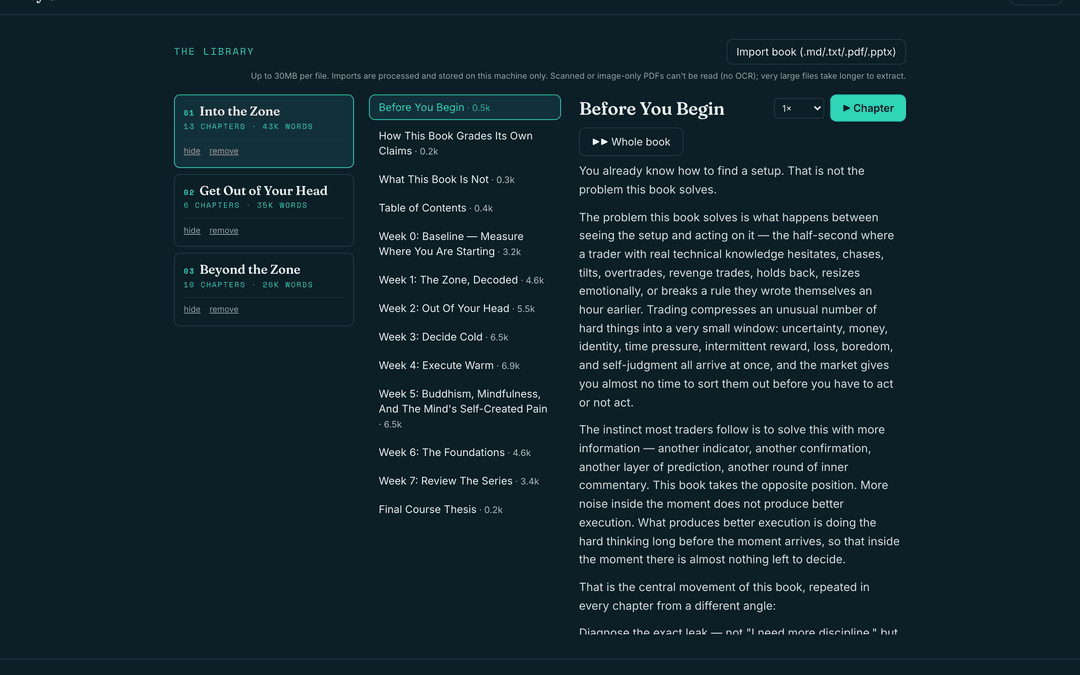
The Library — the trader's own trading-psychology books, embedded on-device; G reads them aloud and quotes them by chapter in coaching.
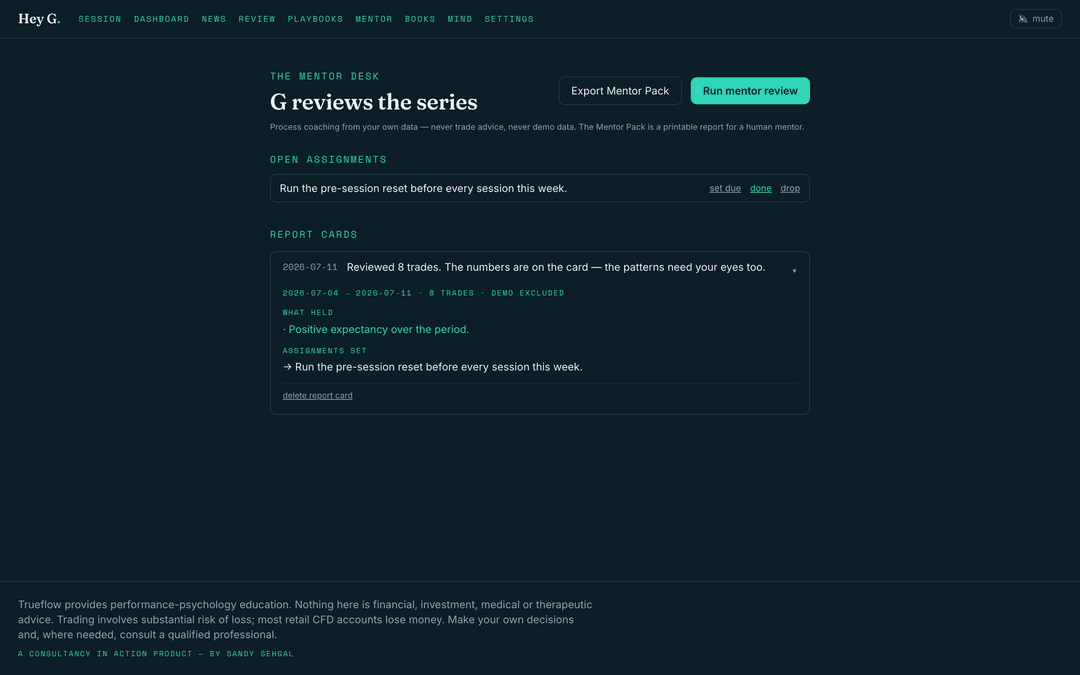
The Mentor Desk — G's weekly report card and one-to-three process assignments he holds you to; export a Mentor Pack for a human coach.
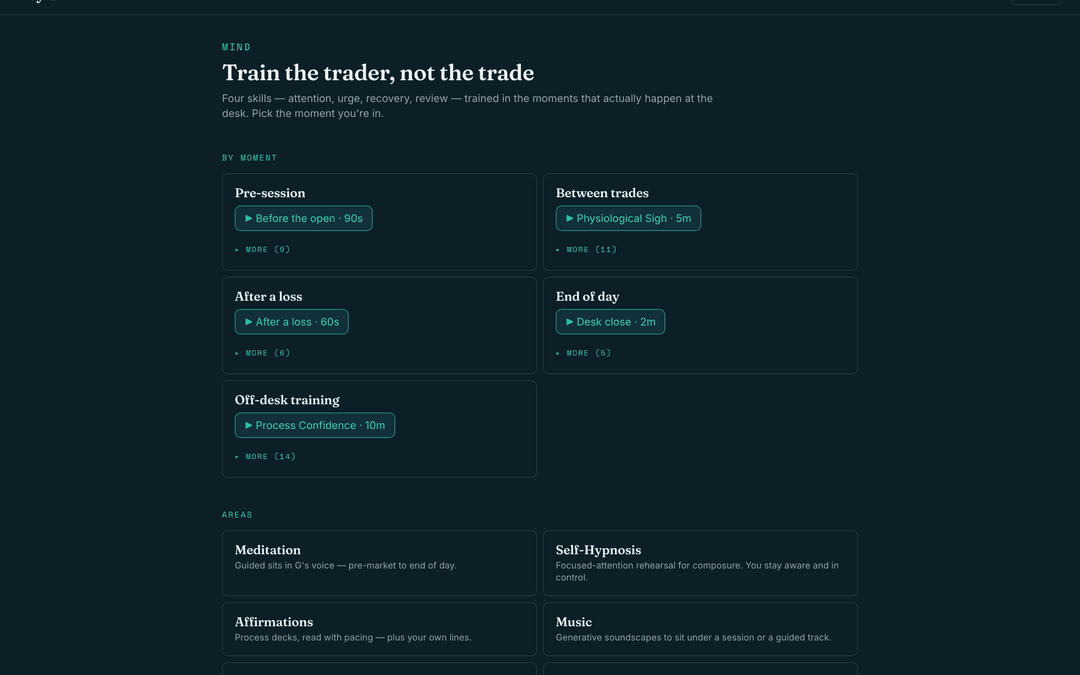
Mind — meditation, breathing, self-hypnosis, affirmations, music and desk-break movement, surfaced by the moment you're in.
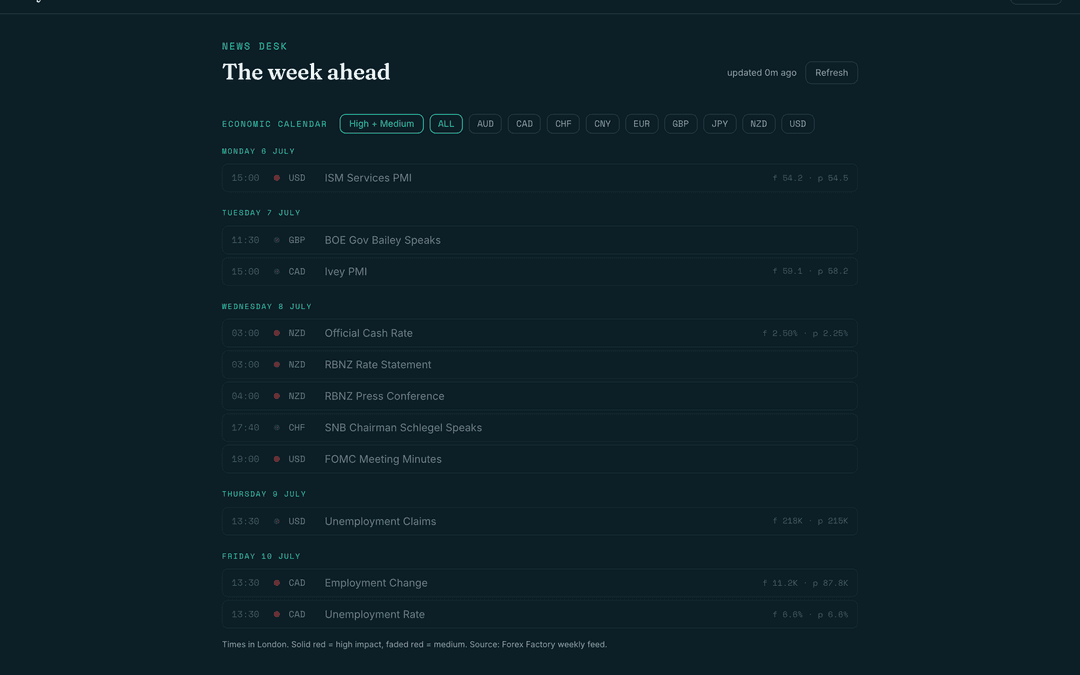
News Desk — the week's economic calendar and headlines; ask G to “review the news” against your own rules, never for a call.
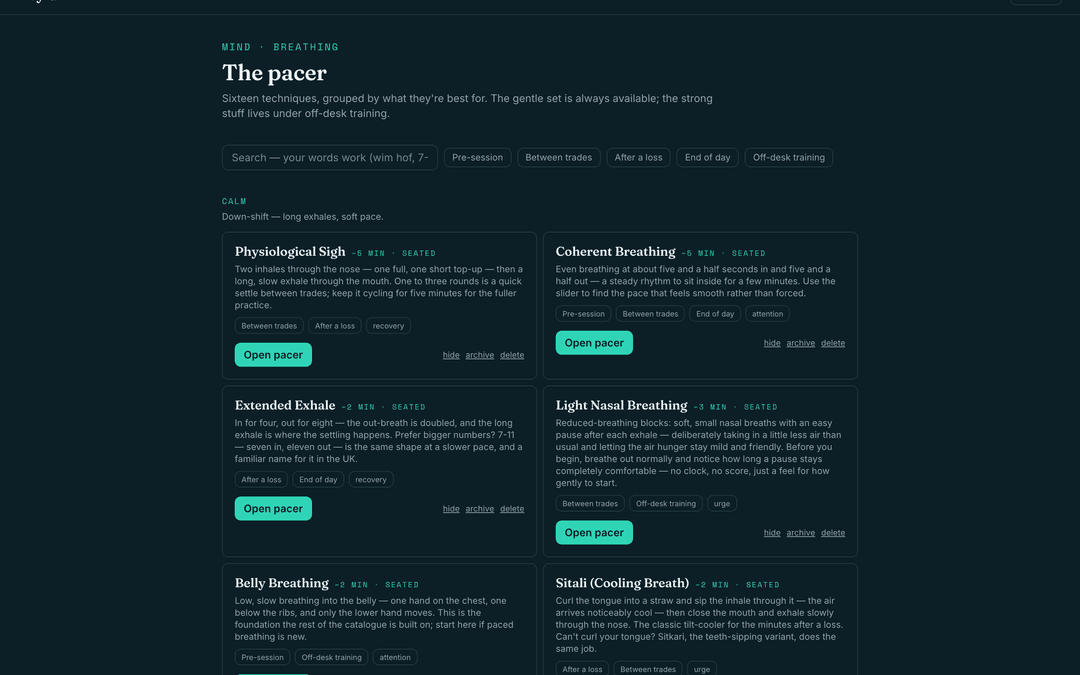
The breathing pacer — sixteen techniques with an animated pacer; say “wim hof” and G finds the safety-gated version.
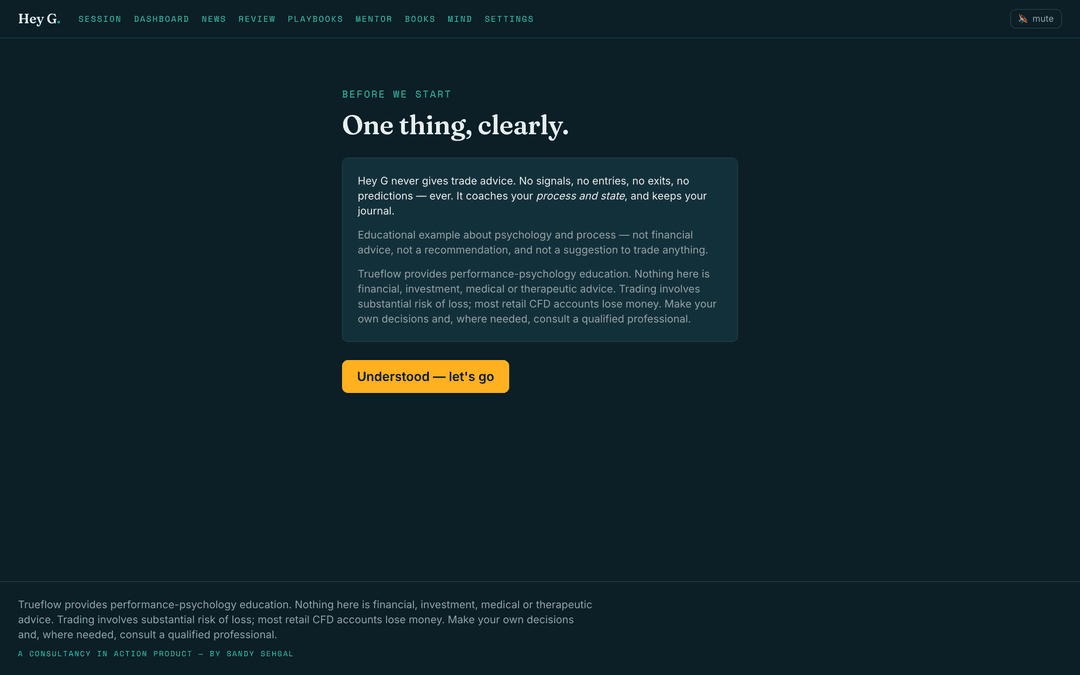
The line, up front — Hey G never gives signals, entries, exits or predictions; a compliance gate opens every session.
The safeguards, in plain English
What it actually does to keep your code and data safe — without the jargon.
It never tells you what to trade
G coaches your process and your state — never signals, entries, exits or predictions. That boundary is built into the app, screened live as he speaks, and checked by a red-team suite that has to pass before any release.
Nothing leaves your machine
The model, your books, your journal, your emotions and your P&L all live on your own device. There's no account and no cloud — and the calm-me-down reset works even with the internet unplugged.
It only knows your books — and shows its working
G's coaching is grounded in the library you load, and he quotes it back with the chapter, so you can check him. It reads like an AI trained on your shelf, but every claim traces to a real page instead of being made up.
It never writes your rules for you
You author your playbooks. G will structure your own words into a checklist and read them back, but he will never invent a trading rule — the discipline stays yours.
It grades the decision, not the money
The Execution Ledger scores the five things you actually control, so a flawless trade that hit its stop counts as a win and a lucky rule-break is flagged as the danger it is. Discipline becomes a number you can raise that has nothing to do with luck.
It's a coach, not a therapist
The breathing, meditation and self-hypnosis are framed as focus and recovery — never treatment. Anything heavier is signposted to a GP or Samaritans, and the calm-me-down reset never pretends to be care it isn't.
Your P&L stays hidden until you choose
Money is kept out of sight so you train the process, not the scoreboard. When you deliberately peek, the peek itself is logged — because noticing the urge is part of the method.
How this compares
Indicative — the same scope, delivered three different ways.
Specialist AI product team
4–8 months
£120k–£220k
Solo freelancer
2–4 months
£55k–£90k
Consultancy in Action — AI-accelerated
AI-accelerated — days
A fraction · £0 to run
By the numbers
What was delivered — verified facts from the build, not projected returns.
Built with
- Next.js 16
- better-sqlite3
- Ollama (local LLM)
- whisper.cpp (local STT)
- Kokoro (local TTS)
- nomic-embed-text (on-device RAG)
- OpenAI Realtime (optional)
- Web Audio (generative soundscapes)
- uPlot
- PWA
- launchd (always-on + nightly backups)
Want something built like this?
We design and ship real, data-driven products — not demos. Tell us what you're trying to make and we'll talk through fit.